
GA Capital · Essentials
Vietnam Roads andTransport Infrastructure
3,345 km of expressway is open and the state wants private capital for the next 2,800 km. Who owns the toll roads, how the tolls and risk sharing work, and where an outside investor can enter.
Need to Know
The network nearly tripled in five years
1,163 km of expressway at the end of 2020 became 3,345 km at the end of 2025. Another 2,111 km was under construction in May 2026.
Public money built three quarters of it
2,485 km came from the state budget and 860 km from PPP. For 2026-2030 the ministry counts US$50.7B of expressway capital, of which US$33.8B is not yet raised.
The rules now share traffic risk
The state can fund up to 70% of a PPP road and pays half of a revenue shortfall below 75% of plan. Tolls on state-built roads started in March 2026.
Executive Summary
Supply arrived faster than planned
Vietnam passed its 3,000 km target and closed 2025 with 3,345 km of expressway main routes. Only 1,238 km is full standard; 1,559 km is limited four-lane and 548 km is two-lane, so widening is the next programme.
The state cannot fund the next phase alone
The ministry puts 2026-2030 expressway capital at about VND 1,269 trillion (US$50.7B) for 2,830 km of new road and 1,190 km of upgrades. About two thirds is unfunded. A pipeline of 29 PPP expressways worth US$35B is in the market.
Cash-yielding roads sit with a few domestic owners
54 BOT projects collected VND 16,236B in 2025. VEC, VIDIFI, Deo Ca and CII hold the roads that carry the traffic. Hanoi-Hai Phong alone collected about VND 3,852B.
Traffic risk is real and now has a remedy
Bac Giang-Lang Son collects 42% of its planned revenue. Eleven BOT projects are proposed for support or early termination. Decree 122/2026 gives older contracts a legal route to share the shortfall.
Foreign capital has entered through platforms, bonds and ports
Metro Pacific bought about 45% of CII Bridges and Roads in 2015 and NEXCO took 20% of a single BOT in 2017. The 2025-2026 deals are IFC into electronic tolling and MSC and APM Terminals into ports.
Expressway length went from 1,163 km to 3,345 km in five years
Another 2,111 km was under construction in May 2026
Expressway main routes open at year end (km)
The 3,345 km by road standard (km)
- 63% of the network is below full standard. Two-lane and limited four-lane sections were built to open the route quickly and are now being widened.
- Density is 2.23 km per 100 km². The ministry plans to invest in 6,539 km before 2030 and about 9,000 km by 2050.
- Provinces run most of the building. Of the 2,111 km under construction, 1,797 km is managed by provinces, 284 km by the ministry and 30 km by VEC.
• Main routes only. With interchanges and access roads the ministry counts about 3,803 km.
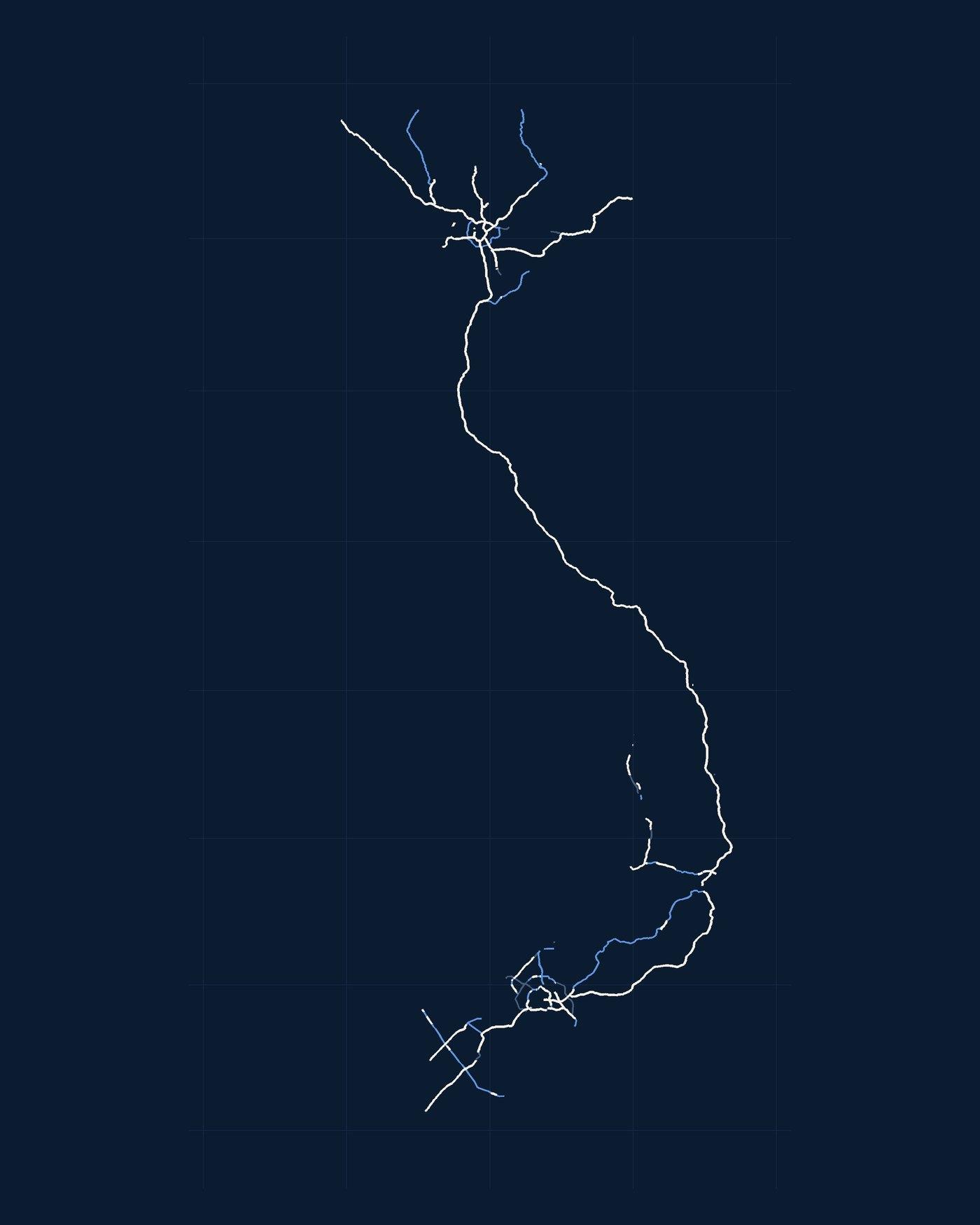
One north-south spine, with ring roads and port links being added around Hanoi and Ho Chi Minh City
Open, under construction and planned expressways, with the airports, ports and ring roads named in this report
US$33.8B of expressway capital for 2026-2030 has no funding source yet
The budget built 74% of the existing network. The next phase is offered to private investors
Expressway capital 2026-2030 (US$ billion)
Who paid for the 3,345 km (km)
- 29 PPP expressways worth about US$35B are on offer. Since 2021 the state has drawn about US$17.8B of private money into 17 BOT projects.
- All transport needs nearly US$115B in 2026-2030. Roads compete with two railways that take 76% of the ministry's 2026 allocation.
- Toll rights on state-built roads are next. In November 2026 the government asked for pilot auctions of toll rights on North-South sections. These are operating roads with a traffic record, sold without construction risk.
- Domestic banks carry the debt. VietinBank alone had VND 36,215B outstanding on 26 PPP projects in August 2026.
The state now funds up to 70% of a PPP road and pays half of a deep revenue shortfall
Six rules that set the cash flow of a Vietnamese toll road
| Rule | What it says | Basis |
|---|---|---|
| State capital in a PPP road | Ceiling raised from 50% to 70% of total investment under set conditions. Build-transfer contracts return. | Law 90/2025/QH15, June 2025 |
| Revenue risk sharing | Below 75% of planned revenue, the state pays half of the gap up to 75%. Above 125%, the project company pays the state half of the excess. | PPP Law, Article 82 as amended |
| Older BOT contracts in shortfall | Contracts signed before 2021 can now share a shortfall or be terminated early with compensation, based on the last three years of revenue and a State Audit review. | Decree 122/2026, April 2026 |
| Tolls on state-built expressways | VND 1,300 per vehicle-km on full-standard four-lane roads and VND 900 on lower-standard sections. Charging began on 2 March 2026 and covered 15 sections by August. | Decree 130/2024 |
| BOT toll increases | The rule allows 12% to 18% every three years. Increases due from 2019 were held back until 29 December 2023, when 41 projects were raised together. | Circular 159/2013 |
| Electronic toll collection | Mandatory on all expressways since 1 August 2022. More than 8 million vehicles carry a tag. VETC, owned by Tasco, holds about 75% of the market. | Ministry of Construction, October 2026 |
State-built expressways collected about VND 3,168B from nearly 34 million vehicle passes between March and 12 October 2026, above plan. That is the first traffic record on roads that had been free, and it is the evidence base for the toll-rights auctions.
54 BOT projects collected VND 16,236B in 2025; the best road earns 127 times the worst
Revenue is concentrated on the Hanoi and Ho Chi Minh City corridors, and 11 projects are in line for state support
2025 toll revenue by road (VND billion)
More than 254 million vehicles passed BOT stations in 2025.
Bac Giang-Lang Son: a shortfall case
Revenue is about VND 52B a month against a plan of VND 123B. The road cost VND 12,189B with 13.5% equity. The province has asked for VND 4,580B of central budget support, the investor return was cut from 11.5% to 9.34%, and the loan rate from 10.5% to 8.53%.
- Eleven projects, about VND 14.2 trillion. Four would receive support of about VND 8,482B and seven would be terminated early. No payment had been confirmed by November 2026.
- A parallel free road takes the traffic. Deo Ca's Ninh Loc station lost 21.8% of its vehicles after the Van Phong-Nha Trang expressway opened.
VEC, VIDIFI, Deo Ca and CII hold the roads that carry the traffic
One state corporation, three listed groups and a short list of private builders
| Operator | Roads | Latest figures |
|---|---|---|
| Vietnam Expressway Corporation (VEC), state-owned | Noi Bai-Lao Cai, Cau Gie-Ninh Binh, HCMC-Long Thanh-Dau Giay, Da Nang-Quang Ngai, Ben Luc-Long Thanh. About 540 km. | 2025 net revenue VND 6,901B (+16%); profit after tax above VND 1,050B |
| Deo Ca Traffic Infrastructure (HHV), listed, Deo Ca Group | Deo Ca, Co Ma, Cu Mong and Hai Van tunnels; Bac Giang-Lang Son; Cam Lam-Vinh Hao; Dong Dang-Tra Linh. 472 km of roads and 31 km of tunnels under management. | 2025 toll revenue VND 2,106B (+10%); net profit VND 678B |
| Ho Chi Minh City Infrastructure Investment (CII), listed | Trung Luong-My Thuan and urban toll assets in Ho Chi Minh City. Trung Luong-My Thuan carried 10.1 million vehicles in 2025. | 2024 toll revenue above VND 2,560B |
| VIDIFI, state-linked | Hanoi-Hai Phong, 105 km. About 65,000 vehicles a day, 3.6 times the 2016 level. | 2025 toll revenue about VND 3,852B, the highest of any BOT road |
| Tasco (HUT), listed | BOT roads and VETC, the main electronic tolling operator: 136 stations and 765 lanes. | VETC 2025 revenue VND 666B (+35%) |
| Phuong Thanh, private | Leads the Hanoi-Thai Nguyen-Cho Moi BOT, 99 km, VND 21,229B. | Bid in 2025 to widen the North-South expressway under PPP |
Approved plans carry an 11.5% to 12.5% equity return on 85% dong debt
Bank loans run 10 to 12 years against toll periods of about 20
| Term | Level | Evidence |
|---|---|---|
| Return on equity in the financial plan | 11.5% to 12.5% | HCMC-Trung Luong-My Thuan expansion 11.77%; Highway 1 Hanoi-Bac Giang 12.53%. Negotiated per contract, not set by law. |
| Loan interest in the financial plan | 10.5% to 11.8% | Dong, floating. |
| Leverage | About 85% debt | HCMC-Trung Luong-My Thuan expansion: VND 36,172B, 15% equity, six banks led by VietinBank. |
| Toll period | 17 to 29 years | About 20 years is typical. |
| Bank loan tenor | 10 to 12 years | Shorter than the toll period, so refinancing risk sits with the sponsor. |
| Cost against a public project | 30% to 50% higher | Interest and investor return, as stated in the National Assembly in April 2026. |
Foreign investors bought a platform stake in 2015 and a single-road stake in 2017; since 2025 the money has gone to tolling and ports
Disclosed foreign transactions in Vietnamese toll roads and transport infrastructure
| Year | Investor | Target | Terms |
|---|---|---|---|
| 2015 | Metro Pacific Tollways (Philippines) | CII Bridges and Roads | About 45% through shares and exchangeable bonds, VND 1.95 trillion (US$91M). Exit announced in 2024. |
| 2017 | NEXCO Central and JEXWAY (Japan) | Phu Ly bypass BOT, FECON | 20% stake in a project of about US$97M. |
| 2025 | IFC | VETC, Tasco | VND 500B (US$19M) convertible bond for electronic tolling. |
| 2026 | Hateco with APM Terminals | Lien Chieu container port, Da Nang | Won the concession; about US$1.7B. Ground broken in April 2026. |
| 2026 | VIMC, Saigon Port and TIL (MSC) | Can Gio transshipment port | TIL 49%, VIMC 36%, Saigon Port 15%; about VND 128.9 trillion. |
Long Thanh airport opens to commercial flights in December 2026; the ring roads follow in 2027 and 2028
Cost and status of the projects that change traffic patterns around the two main cities
| Project | Cost | Status |
|---|---|---|
| Long Thanh International Airport, phase 1 | US$4.2B to 4.4B | Commercial flights set to begin on 24 December 2026. Capacity 25 million passengers a year. |
| Ho Chi Minh City Ring Road 3 (76 km) | VND 75,300B | About 76% built in November 2026. Full route targeted for the end of 2026. |
| Ho Chi Minh City Ring Road 4 | VND 120.4 trillion | BOT, ten sub-projects. First component started in June 2026. Target 2028. |
| Hanoi Ring Road 4 | VND 85.8 trillion | PPP expressway component started in September 2025. Target November 2027. |
| Bien Hoa-Vung Tau expressway (54 km) | VND 17.8 trillion | Fully open since 18 May 2026. |
| Ben Luc-Long Thanh expressway (58 km) | VEC | Full opening with Phuoc Khanh bridge at the end of September 2026. |
| HCMC-Moc Bai expressway (51 km) | VND 19,617B | BOT component started in July 2026. Target December 2027. |
| Chau Doc-Can Tho-Soc Trang (188 km) | VND 44,691B | First 57 km open since December 2025. Full route now July 2027. |
| Lao Cai-Hanoi-Hai Phong railway | VND 289 trillion | Started in December 2025. Budget raised in August 2026. |
| North-South high-speed railway | US$67B | Ground-breaking moved to December 2027. Vingroup withdrew its bid in December 2025. |
| Gia Binh airport | US$7.5B | Developer Masterise. Started in August 2025. Target 2027. |
| HCMC metro line 2 (11 km) | VND 47.8 to 57 trillion | Started in January 2026. Target 2030. |
The car fleet passed 7 million in 2026 and the busiest expressway runs at about three times its design load
Car ownership was about 68 per 1,000 people at the end of 2024
- HCMC-Long Thanh-Dau Giay carries 50,000 to 55,000 vehicles a day, about three times its design, with traffic growing 10.8% a year. Widening started in August 2025.
- Hanoi-Hai Phong carries about 65,000 vehicles a day, 3.6 times the 2016 level, and its owner has proposed widening to eight or ten lanes.
- VEC's network grew 9.4% in the first half of 2025, to nearly 37 million vehicles.
Three entry routes: a platform stake, structured capital into one road, or toll rights on a state-built section
Operating roads price on traffic history; roads under construction carry land, cost and ramp-up risk
Minority stake in a multi-road platform
Several operating roads under one holding company spread traffic risk. Metro Pacific used this route in 2015. The buyer depends on the sponsor for governance and on dividends for cash.
Structured capital into a single BOT
Convertible or preferred capital sits between 85% bank debt and thin sponsor equity. Bank loans mature in 10 to 12 years, so the sponsor needs capital that waits longer.
Toll rights on a state-built road
The pilot auctions announced in November 2026 sell the right to collect on finished North-South sections. Tolling began in March 2026, so the traffic record is short.
Diligence items that move the price
- Traffic against the original forecast, and any parallel free road planned or under construction.
- The toll step-up schedule in the contract, and whether past increases were applied on time. The 2019 to 2022 increases arrived in December 2023.
- Remaining toll period and loan maturity. Deo Ca's contracts run from 2035 to 2049.
- Whether the contract can use risk sharing. New PPP contracts have it by law; contracts signed before 2021 depend on Decree 122/2026.
- Currency. Tolls are collected in dong, so hard-currency funding carries the exchange rate.
Vietnam toll road opportunities
GA Capital advises on toll road and expressway transactions in Vietnam. Material on current transactions is shared with qualified investors under a confidentiality agreement.
Sources
- Viet Nam News: over 3,800 km of expressways opened (May 2026)
- Minister of Construction to the National Assembly: expressway capital 2026-2030 (April 2026)
- VnEconomy: record 475 km opened in 2023
- VIR: Vietnam steps up expressway funding efforts (September 2026)
- VietNamNet: US$35B sought for 29 expressway projects (November 2026)
- VietNamNet: funding the US$115B transport need (October 2026)
- VietNamNet: pilot auctions of North-South expressway toll rights (November 2026)
- Lao Cai newspaper: VND 3,200B collected on state-built expressways (October 2026)
- Bao Dau Thau: risk sharing in three transport PPP projects (July 2026)
- Tin Nhanh Chung Khoan: Bac Giang-Lang Son revenue shortfall (May 2026)
- Saigon Times: 54 BOT projects collected VND 16,200B in 2025
- Deo Ca Traffic Infrastructure (HHV): Q4 2025 investor bulletin
- Nguoi Quan Sat: VEC 2025 results (June 2026)
- Bao Dau Tu: investors selected for HCMC-Trung Luong-My Thuan expansion (November 2025)
- VietnamPlus: Metro Pacific investment in CII Bridges and Roads (2015)
- NEXCO Central: Phu Ly bypass BOT investment (2017)
- IFC: investment in VETC (July 2025)
- Government News: Lien Chieu container port award (March 2026)
- Government News: Can Gio transshipment port investor (April 2026)
- VOV: Long Thanh airport commercial start on 24 December 2026
- Government News: North-South high-speed railway start (September 2026)
- Dan Tri: car fleet and registrations (July 2026)
- VIR: logistics costs at 16% of GDP
- Expressway lines on the map: OpenStreetMap contributors